IDS 493: Professional Portfolio Project
Note: Artifacts from my coursework, including assignments and journal entries, are available through the navigation bar at the top of this site under their respective course pages (CYSE 200T, CYSE 201S, CYSE 270, CYSE 368). The artifacts on this page focus on professional, research, and extracurricular work that complements my academic portfolio.
Artifacts & Skills
Skill 1: Infrastructure & Automation
I developed this skill primarily through my job as a System Administrator at the ODU Department of Computer Science. The role had me managing Linux servers and desktops with configuration management tools and running containerized services for the department. It forced me to take what I had learned in networking and operating systems classes and actually apply it to systems that real people depended on every day. Most cybersecurity and DevOps job postings I have looked at list infrastructure automation as a core requirement, so this felt like one of the most directly career-relevant skills I picked up during my time at ODU.
Artifact 1: Ansible/Kubernetes Scripts
Ansible/Kubernetes Scripts
These are Ansible playbooks and Kubernetes manifests I wrote as a System Administrator at the ODU Department of Computer Science. I used Ansible to automate how we configured and maintained Linux servers and desktop workstations across the department. Kubernetes handled the deployment and management of user-facing services in containers. Ansible uses a declarative YAML syntax where you describe the desired end state of a system and the tool figures out how to get there. Each playbook had to be idempotent, producing the same result regardless of the system's starting condition. My playbooks handled everything from package installation to user account provisioning and security hardening across dozens of machines simultaneously. On the Kubernetes side, I wrote manifests that defined how containerized services were deployed, scaled, and networked together, giving the department a reproducible and version-controlled infrastructure.
Artifact 2: AERMOR Inventory Management Site
AERMOR Inventory Management Site
During my Software Development Internship at AERMOR in the summer of 2024, I worked with a team of interns to build an inventory management web application using Blazor and C#. AERMOR is a defense and cybersecurity services company, and they did not have a centralized way to track their electronic devices internally. Our team designed and developed a full-stack solution that let employees catalog and manage hardware assets. The application included features for searching the device inventory, assigning devices to personnel, tracking device locations, and logging changes over time. We built the front end in Blazor's component-based framework and connected it to a C# back end with a relational database for persistent storage. The project followed agile development practices with sprint planning and code reviews.
Artifact 3: Discord Bot Template
Discord Bot Template
The v12 Discord Bot Template is an open-source TypeScript starter project built with discord.js. It gives developers a modular command handler framework they can clone and start building on right away. I released it because I wanted to contribute something useful to the open-source community and lower the barrier for people getting started with bot development. The template uses a modular architecture where each command lives in its own file and gets dynamically loaded at runtime, so developers can add new commands without modifying the core bot logic. The project includes a structured directory layout, TypeScript type definitions, and event handling boilerplate. It has been starred and forked by other developers on GitHub, and I have maintained it through multiple discord.js version updates.
Skill 2: Professional Qualifications
Certifications and a strong professional portfolio show employers that you can do the work. Earning the CompTIA Security+ and GIAC GFACT required me to pull together knowledge from across my coursework and apply it under exam conditions. My GitHub profile serves a different but related purpose. It is a running record of what I have actually built over the years. These qualifications go beyond what a transcript can show and give employers concrete evidence of what I am capable of.
Artifact 4: CompTIA Security+
CompTIA Security+
I earned the CompTIA Security+ certification in May 2024. It is an industry-standard credential that covers a wide range of security topics from threat identification to cryptography and risk management. The U.S. Department of Defense recognizes it under DoD 8570, and it shows up in just about every cybersecurity job posting I have looked at. The Security+ exam (SY0-701) tests across six domains: general security concepts, threats and vulnerabilities, security architecture, security operations, security program management, and cryptography. It includes both multiple-choice and performance-based questions where you have to work through simulated scenarios. CompTIA reports that Security+ holders often work in roles like security administrator, systems administrator, and security engineer.
Artifact 5: GIAC GFACT
GIAC Foundational Cybersecurity Technologies (GFACT)
The GIAC GFACT certification (Credential ID 3868) covers foundational cybersecurity and IT knowledge. It validates understanding of operating systems, networking, system administration, and introductory security principles. GIAC certifications come from the SANS Institute and are known for being practical and rigorous. The GFACT specifically tests across areas including Linux and Windows operating systems, networking concepts and protocols, basic scripting and programming, and foundational security topics. Unlike many entry-level certifications, GIAC exams are proctored and require demonstrating applied knowledge rather than rote memorization. The SANS Institute developed the GFACT to certify that holders have a broad technical foundation that spans multiple IT disciplines.
Artifact 6: GitHub Code Repository
GitHub Code Repository
My GitHub profile has 161 repositories. I work primarily in TypeScript and Svelte but have projects in Python, C#, and other languages as well. My pinned repositories include Fitzwilliam (a Discord bot for the ODU CS server), Forgetti (AI-powered 3D print failure detection), Hintable (a word guessing game), and LingoLearn (an AI-powered language learning app). I actively maintain all of my repositories and have earned the Arctic Code Vault Contributor achievement, which means my code was archived in GitHub's Arctic Code Vault in Svalbard, Norway as part of a program to preserve open-source software for future generations.
Skill 3: Advanced Technical Research
Research has been one of the most rewarding parts of my time at ODU. Through the Perry Honors College and a collaboration with NASA, I got to work on problems that did not fit neatly into a single discipline. From using computer vision to detect 3D printer failures to building AI models for materials science, each project forced me to learn something new. That ability to work across fields is something I want to carry into my career, especially in cybersecurity where new problems rarely come with a textbook solution.
Artifact 7: Forgetti AI
Forgetti AI Failure Detection
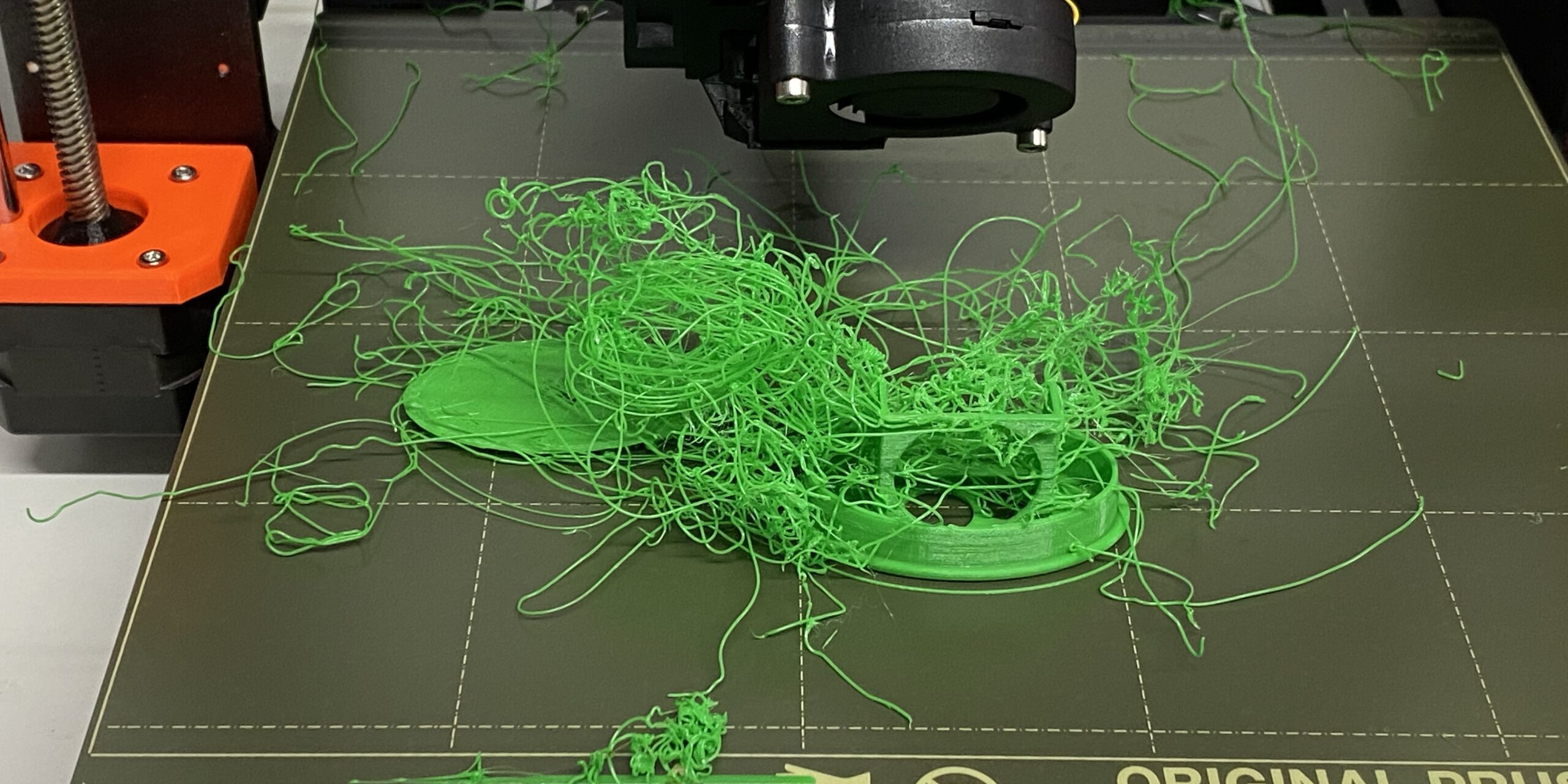
Forgetti is a full-stack SvelteKit web application that uses YOLOv12 computer vision to detect 3D printer failures in real time. I developed it as part of a research grant through the ODU Perry Honors College. The idea was to build a better alternative to existing print failure detection software by using AI object detection to spot problems like spaghetti (when filament stops adhering and tangles into a mess). Users can monitor their prints through a web interface and get alerts when something goes wrong. YOLOv12 (You Only Look Once) is a real-time object detection model that I trained on a custom dataset of 3D printer failure images. The training process involved collecting and labeling hundreds of images of both successful prints and common failure types, then iterating on the model's hyperparameters to reduce false positives while maintaining reliable detection. The web application streams video from a camera pointed at the printer and runs inference on each frame, overlaying bounding boxes on detected failures.
Artifact 8: Makerspace Security Research
Makerspace Security Research
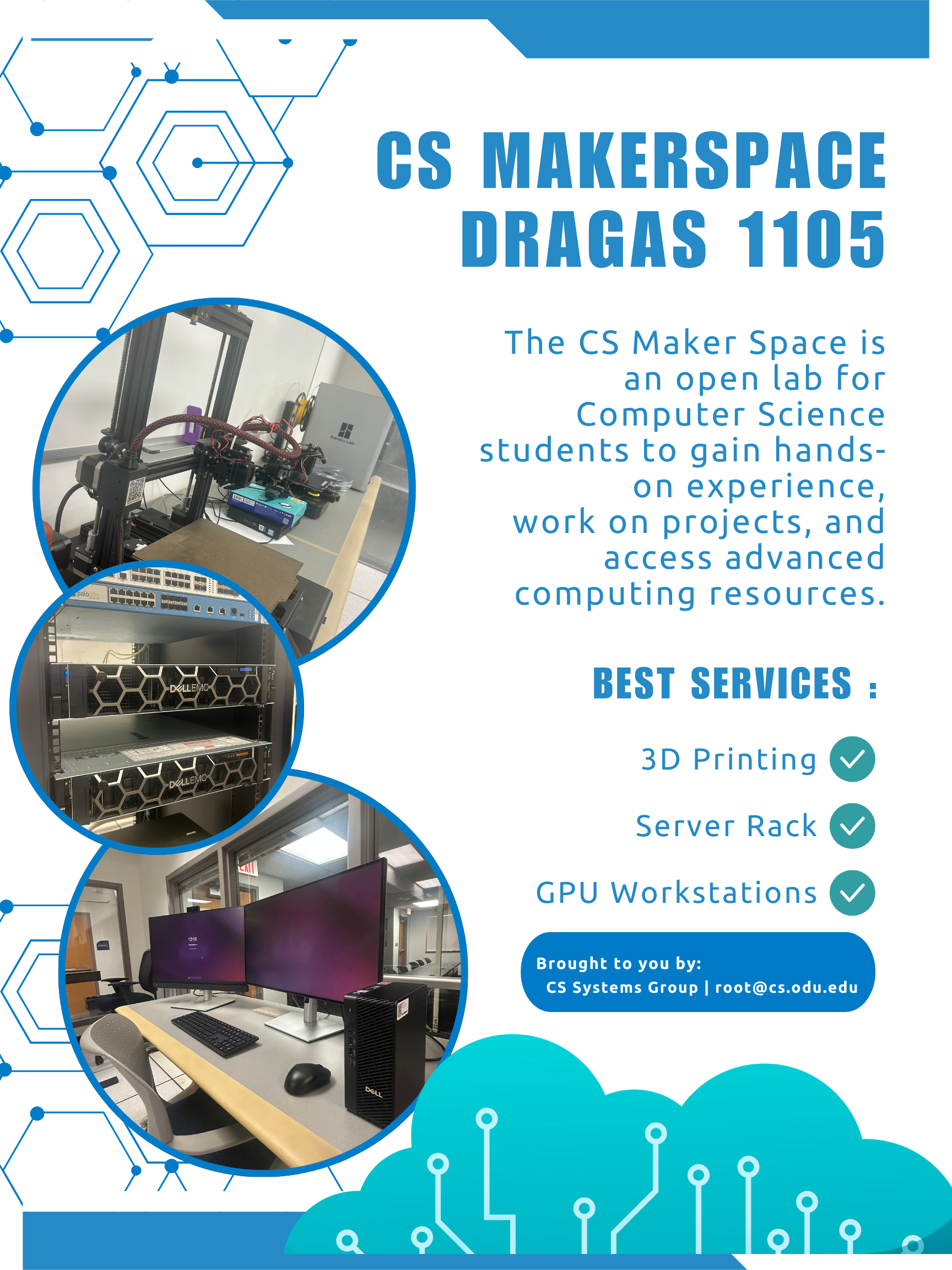
This research was conducted at the ODU Computer Science Makerspace, an open lab located in Dragas 1105 that provides Computer Science students with hands-on access to advanced computing resources. The space is managed by the CS Systems Group and offers 3D printing, a server rack, and GPU workstations for student use. My research was a comprehensive security assessment that looked at both physical and digital security. On the physical side, I examined access control to the room and surveillance of the equipment. On the digital side, I assessed the network security of the server rack and GPU workstations, including how they were segmented from the broader university network and what authentication was required to access them. The 3D printers and GPU workstations are valuable shared resources, and the goal was to evaluate how well the space was protected against unauthorized access, both in person and over the network, during and outside of staffed hours.
Artifact 9: NASA Diffusion Stiffness Research
NASA Diffusion Stiffness Research

I worked with an ODU professor and NASA material scientists on a project developing a diffusion AI model. The model uses ultrasonic testing data to predict the toughness values of composite materials, specifically two pieces of aluminum bonded together. The idea is to use machine learning to determine material properties without destructive physical testing, which has applications in aerospace manufacturing and quality assurance. Ultrasonic testing works by sending sound waves through a material and analyzing how they propagate and reflect. The patterns in the ultrasonic data contain information about the material's internal structure, including the quality of the bond between the aluminum layers. My role was to build a machine learning model that could take this raw ultrasonic data and predict the material's toughness value, a measurement that traditionally requires physically breaking the sample to determine. By making this prediction non-destructively, the approach could allow manufacturers to test every part on a production line rather than destroying a sample from each batch.
Resume
Reflection Essay
Introduction
Across the United States, hundreds of universities provide undergraduate Cybersecurity programs. However, very few of these institutions are among the 187 R1 research universities ranked by Carnegie Mellon with high research activity. Old Dominion University has the honor of holding this distinction which is reflected tremendously in the cybersecurity curriculum of the university, as students are expected to perform rigorously to meet strict academic standards. As a part of the Interdisciplinary Schools at the university, cybersecurity students participate in a synthesis of technical and social skills, enabling them to not only carry out their future workplace responsibilities but do so in a way that is ethical and considers the nuance of the various fields that intersect with information technology and computer science as a whole (Repko & Szostak, 2017). I have had the pleasure to be one of these students. Through both extensive class participation and studious research outside of the classroom, I have developed a set of skills that will be instrumental in securing a job and everlasting career following my graduation from the university.
While I must admit that the majority of my practical skills came through real-world practice through my job at the university and my hobbies outside of class, my academic training has supplemented my knowledge and widened the breadth of my understanding. Instead of simply solving a problem, my courses taught me to analyze the underlying causes and evaluate the ethical implications of proposed solutions. While courses like CYSE 450 (Ethical Hacking and Penetration Testing) taught me the foundational technical skills, my active participation in the social aspect of the field has been an integral part of my journey. In CYSE 201S (Cybersecurity and the Social Sciences), I learned about the social, political, legal, criminological, and economic dimensions of cybersecurity which enabled me to devise human-first solutions to cybersecurity threats (Al-Alawi et al., 2019). Furthermore, CYSE 368 (Cybersecurity Internship) enabled me to go beyond simply working in the field by providing me the opportunity to reflect and grow on my hardships and successes in the field. The development of this ePortfolio serves as a capstone for my journey, enabling me to synthesize my diverse experiences, from system administration to AI software development, into a coherent narrative of my professional identity.
Skill 1: Infrastructure & Automation
The skills that I have acquired most recently and have developed over the last two years involve infrastructure automation and management. Through my position as both a Systems Administrator and formerly a Consultant for the Computer Science department, learning how to maintain Linux, Windows, and Networking machines and equipment was an instrumental part of the career advancement process. As a result, I was highly motivated to develop my skills in these areas, especially since my skills in web development were overshadowed by recent rises in Artificial Intelligence algorithms that can write code for you. While my certifications and advanced research are equally important parts of my synthesized portfolio, my everyday work that earns me my living is credited mostly to my tangible knowledge of programming languages and DevOps tools.
The first tangible piece of evidence that supports my skillset in infrastructure and automation are the Ansible playbooks and Kubernetes manifests that I wrote during my tenure as a System Administrator in the Department of Computer Science. These tools rely on using declarative infrastructure as code (iaC) files in the YAML language format to ensure idempotent deployment and management of services and tools on our network (Chijioke-Uche, 2022). Ansible is a framework for applying changes to an entire infrastructure over SSH, whereas Kubernetes is a framework for orchestrating pods, and ultimately applications, across an infrastructure. These tools are used by industry professionals, and they are backed by the institutional power of Red Hat, Inc and Google LLC, respectively. These two powerful pieces of software work in tandem to support our infrastructure. For example, I use ansible to push updates to computers and manage the bare-metal Kubernetes cluster, while I use the Kubernetes manifests to manage the actual deployment and lifecycle of applications on our infrastructure.
My next two artifacts encompass my skills in software development and web design, and they connect with the previous skill greatly. While being able to deploy software is an excellent skill to have, there are many problems that require custom-built solutions that can only be solved through new and novel software. I have made multiple applications for the university, including our AI chatbot website available at https://ai.cs.odu.edu, as well as a custom digital signage solution called RelayPoint, which displays slideshows on all the televisions in the control of the Computer Science department. These two pieces of software were developed with SvelteKit, a framework similar to React or Vue. Despite being the new kid on the block, SvelteKit has soared in popularity in recent years, leading me to prioritize learning it over traditional frameworks. Before working at Systems Group, however, I gained a plethora of experience in software development through my internship at Aermor as well as through my personal hobbies and ambitions. While working over the summer at Aermor LLC, a defense contractor and cybersecurity firm, I worked with a team of interns to develop an inventory management system using the C# programming language and the Blazor web framework. While I had a solid foundation through my hobbies, being able to apply my skills in a team setting helped prepare me for the real-world challenges of software engineering that exist outside of a developer working alone.
Finally, I credit most of my knowledge and understanding not to academia or the institutions of labor, but to my own personal ambition and desire to learn more. At home, I dedicated lots of time to learning how to make websites using information freely available on the Internet. The age of the internet has led to the democratization of information that has slowly made the need for a formal education nearly irrelevant. As early as elementary school, I used the Internet to first learn Javascript, followed then by Python, C#, and their respective common libraries and tooling. One notable example from my portfolio, which I credit with the start of my true breadth of knowledge into the field, is my creation of a Discord bot using the discord.js framework and JavaScript, which I completed in the early years of high school. Since then, I have leveraged my knowledge of JavaScript to create various other full-stack web applications. For example, I created an AI-powered language learning tool called LingoLearn entirely from scratch, which required me to understand SvelteKit, databases, application security, and deployment at scale.
Skill 2: Professional Qualifications
Being able to develop full-stack web applications is a core part of my skillset, and therefore a large part of my professional qualifications, and it is illustrated through my GitHub profile. As mentioned above, all of my prominent web applications are available here publicly as open source software for anyone to modify or enjoy to their liking. Besides LingoLearn, my pinned repositories include Fitzwilliam (a Discord bot for the ODU CS server), Forgetti (AI-powered 3D print failure detection), and Hintable (a word guessing game). Each of these applications required synthesis of the front-end and back-end architectures, requiring me to think critically and deeply about implementation and security. I believe that tangible software is the great piece of evidence for one’s qualifications and the most powerful part of my portfolio.
However, it is also important to acknowledge the benefits of earning certifications that establish a baseline level of knowledge and ensure employers hire a qualified candidate. After all, while code can be generated by artificial intelligence, it is almost impossible to cheat on a proctored exam. As a result, employers can have security in knowing that I meet the qualifications I claim to possess. I have earned two certifications related to the field of cybersecurity, CompTIA Security+, and the GIAC Foundational Cybersecurity Technologies (GFACT) certification. These certifications are significant as they are universally recognized by hiring managers and security professionals, serving as a standardized validation of my foundational knowledge (Payne et al., 2022). The CompTIA Security+ certification is considered one of the most influential certifications in the industry, and it is widely considered a must-have among rising professionals. The CompTIA Security+ provided me with a high-level overview of threat landscapes and risk management principles, while the GFACT gave me a rigorous, technical deep-dive into secure systems architecture. When my certifications are used in tandem with my portfolio, I am able to demonstrate to employers that I possess a balanced professional profile that moves beyond just theoretical knowledge or raw application but into nuanced synthesis of the two to solve complex problems using established industry standards.
Skill 3: Advanced Technical Research
Since I have had the pleasure of attending an R1 research university, I have taken advantage of various opportunities to grow my knowledge through the pursuit of scientific research. I believe this is the most unique part of my portfolio, as while most industry professionals may have a software portfolio and certifications, very few have engaged in funded academic research to solve complex problems. My most significant research experience was when I received a $6,000 grant to develop the aforementioned Forgetti software. This research project represents a significant step in my growth within the field of cybersecurity, as it required me to integrate my software development skills that I acquired through work, my cybersecurity mindset that I acquired through my coursework, and my academic ability to research and develop a novel artificial intelligence algorithm for identifying 3D printing defects and failures. The project was ultimately successful, and it enabled me to create a deliverable tool that helps fight against the dangers of industrial sabotage and accidents.
My experience with advanced technical research did not stop here, however, as I have engaged in other research projects as well through the university. For example, I received a $1,000 grant to create and secure the ODU Computer Science makerspace. I can credit a few of my courses for enabling me to complete this task. For instance, CYSE 301 (Cybersecurity Techniques and Operations) taught me how to use network analysis tools like nmap to explore and map networks, allowing me to verify my implementation of network segmentation in VLANs within the CS Makerspace. Furthermore, CYSE 270 (Linux System for Cybersecurity) taught me the basics of managing Linux machines, which was crucial as the lab space is made up entirely of Ubuntu desktop machines. Without this academic foundation, my ability to conduct the research would be incomplete. Finally, it is important to note that technical writing is a requirement for a cybersecurity professional. While all of my courses required me to produce essays as part of the curriculum, IDS 300W ( Interdisciplinary Theory and Concepts) served as the ultimate example of writing synthesis, as I had to draw from three different major disciplines to synthesize a novel research paper. While technical and soft skills are integral to the day-to-day operations of an organization, technical writing is the essential bridge that communicates these complex solutions to stakeholders.
Conclusion
As I reflect on my time at Old Dominion University, I can say without a doubt that I am prepared to enter the workforce. No other program provides students with such an in-depth and nuanced understanding of the field of cybersecurity as the interdisciplinary program at ODU does. When I evaluate my skills in infrastructure automation, my various professional qualifications, and my advanced technical research as a whole, it is clear that technical prowess alone is insufficient for lasting success in this field. Interdisciplinary methods and theories were vital to my understanding of my coursework, as they taught me that every technical problem is deeply intertwined with human behavior and ethical considerations (Frusci, 2024). As a result, I was able to engage with assignments beyond simply solving a technical problem but instead understanding the overarching societal affects my career will have on the people and institutions around me. While the low level cybersecurity courses gave me the foundational knowledge necessary for carrying out my job responsibilities, the higher level courses taught me how to synthesize knowledge and disciplines to solve complex problems, which culminated in IDS 300W and in this course, IDS 493. As a result, through the synthesis of my academic studies, professional development, research, and hobbies into an ePortfolio narrative, I demonstrate to employers and to university officials that I am confident and capable in my abilities as a cybersecurity professional.
References
- Al-Alawi, A. I., et al. (2019). Interdisciplinary Cybersecurity: Rethinking the Approach and the Process. ResearchGate.
- Chijioke-Uche, J. (2022). Infrastructure as Code Strategies and Benefits in Cloud Computing. Walden University ScholarWorks.
- Frusci, J. (2024). Integrating Humanities into Cybersecurity Education: Enhancing Ethical, Historical, and Sociopolitical Understanding in Technical Training. Journal of Cybersecurity Education, Research and Practice.
- Payne, B. K., Cross, B., & Vandecar-Burdin, T. (2022). Faculty and Advisor Advice for Cybersecurity Students: Liberal Arts, Interdisciplinarity, Experience, Lifelong Learning, Technical Skills, and Hard Work. Journal of Cybersecurity Education, Research and Practice.
- Repko, A. F., & Szostak, R. (2017). Interdisciplinary Research: Process and Theory (3rd ed.). SAGE Publications.